Backend Development: APIs, Data, Security and Systems That Scale
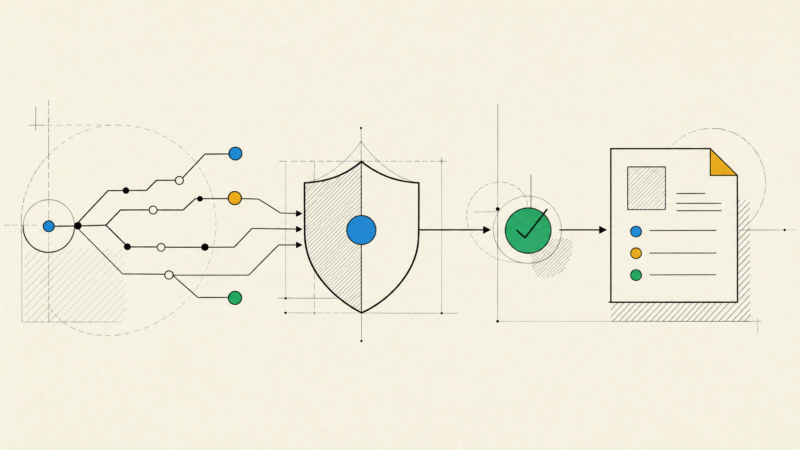
What goes into a backend that holds up: contract-first APIs, careful data modeling, standard auth, queues for slow work, observability from day one and honest stack choices.
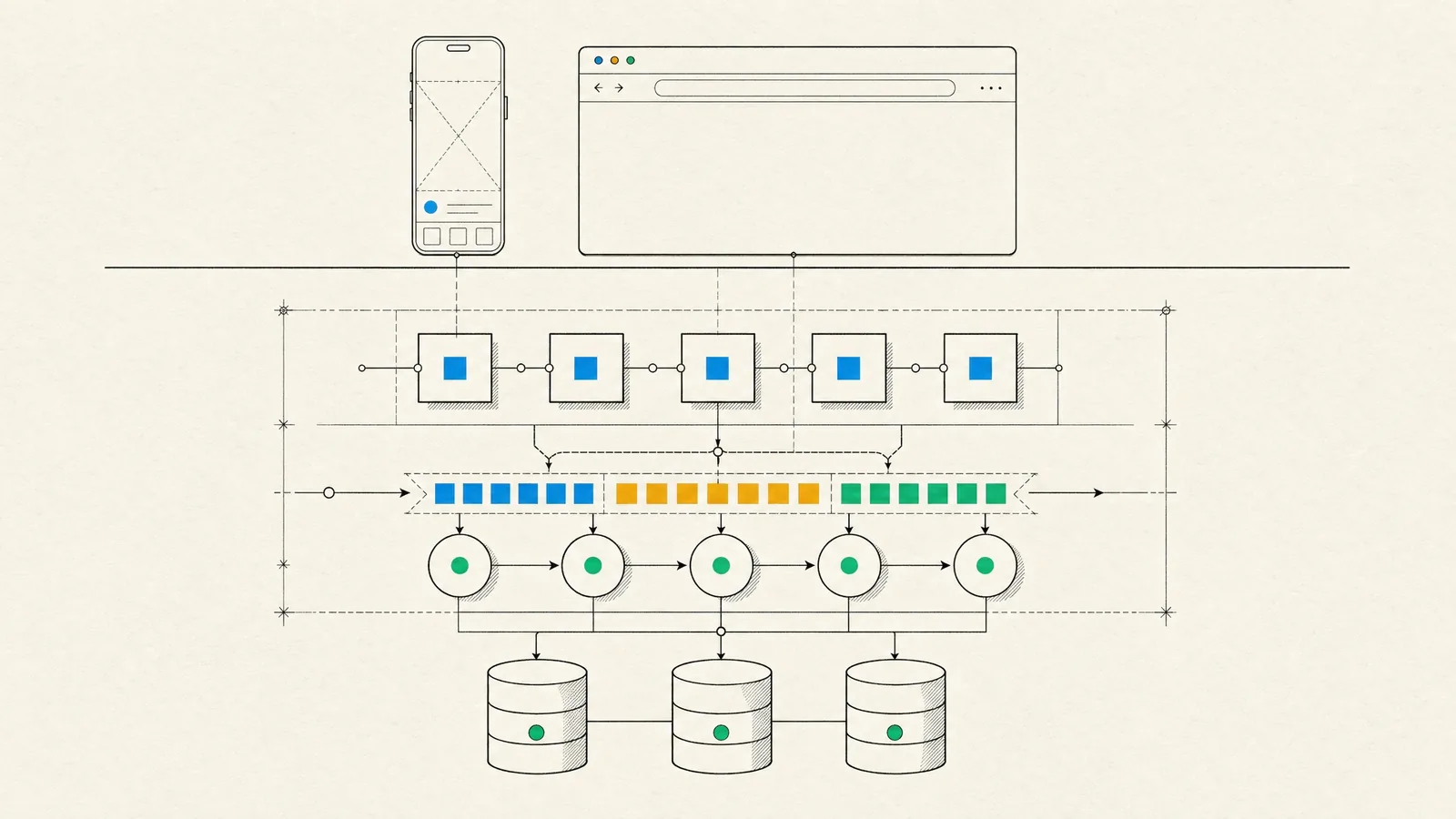
Every screen in your product relies on work users never see. APIs answer its requests, a database keeps its data correct, and background jobs send its emails and settle its payments. Backend development is the job of making that hidden layer fast, secure and dependable, so people can trust the interface that sits on top of it.
In production, a good backend is boring. Responses come back quickly and predictably. Data stays consistent even when a process dies halfway through, and sign-in and permissions hold up under scrutiny. When something does go wrong, your team can see what happened without reconstructing it from customer complaints.
What we build behind the screen
- APIs for web products and mobile apps, including backends-for-frontends that shape responses for a single client.
- Integrations with payment providers, ERPs, CRMs, identity providers, and banking or government APIs, along with the retries and reconciliation those systems demand.
- Admin panels and back-office tools for the people who run the product day to day.
- Data ingestion and processing, such as telemetry from IoT devices, bulk file imports and media pipelines.
- Real-time features like live dashboards, notifications, chat and collaborative editing.
- Systems where the domain is the hard part: ledgers and reconciliation in FinTech, document workflows in LegalTech, sensitive health records in MedTech, orders and inventory in e-commerce.
API design and data modeling
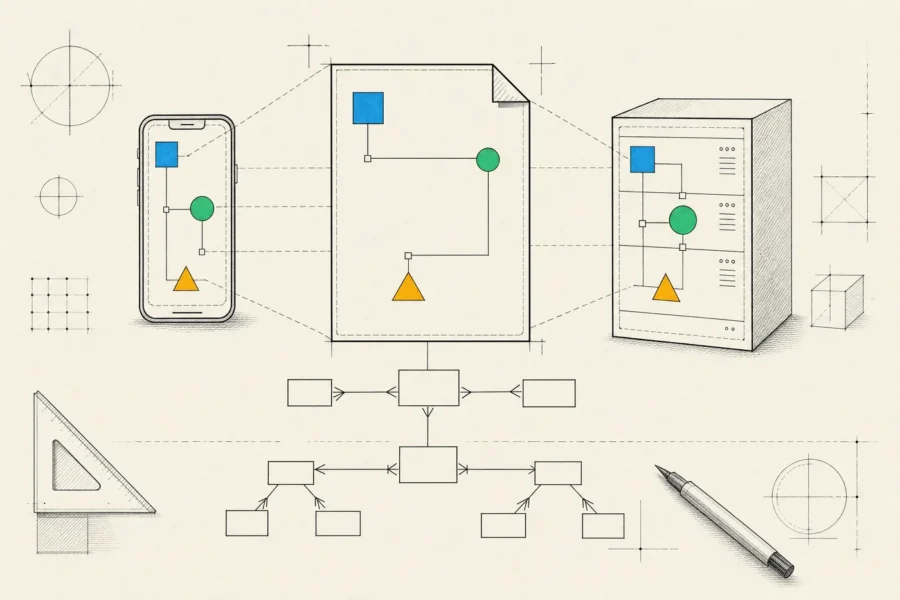
We design the API contract before writing the implementation. Usually that’s an OpenAPI description, or a GraphQL schema when many clients need different shapes of the same data. Frontend and mobile engineers review the contract, generate typed clients from it, and build against mocks while the backend is being written. A few conventions save a lot of pain later:
- One documented error format for the whole API, for example the Problem Details standard.
- Cursor-based pagination for large or fast-changing lists.
- Idempotency keys on operations that must never run twice, like payments and order creation, so a mobile client on a flaky connection can retry safely.
- Additive changes by default, and deprecations announced ahead of time, since you can’t force installed mobile apps to update overnight.
Contract tests in CI then check that the implementation still matches the published spec, so the documentation doesn’t drift away from what the API actually does.
Data modeling starts with the domain: the entities, the rules that must always hold, and the lifecycle each record moves through. PostgreSQL is our default, and we let the database enforce whatever it can, with foreign keys, unique and check constraints, and transactions around anything that has to succeed or fail as a whole.
We store money as integer minor units or fixed-precision decimals, never as floating point, and timestamps in UTC. Schema migrations are versioned and reviewed, and they follow an expand-and-contract approach so deployments don’t need downtime. Endpoints get integration tests that run against a real database rather than mocks.
Other stores come in only when they earn a place: Redis for caching and rate limits, a search engine for full-text search, object storage for files, a time-series database when telemetry gets heavy. Large uploads go straight to object storage through pre-signed URLs, so they never tie up the API servers.
Authentication, authorization and security
Authentication should be standard and unremarkable. We use OAuth 2.0 and OpenID Connect, either through a proven identity provider or the framework’s own auth. Passwords are hashed with Argon2id or bcrypt, multi-factor authentication is supported, and enterprise customers get SAML or OIDC single sign-on. In the browser, sessions live in secure, HttpOnly cookies rather than tokens in local storage. Mobile apps get short-lived access tokens with rotating refresh tokens.
Serious incidents tend to start with authorization. OWASP ranks broken object-level authorization (a user reaching someone else’s records by changing an ID) as the top API security risk. So the server checks every request against who is asking, what they’re asking for and which tenant it belongs to, and those checks have automated tests of their own.
In multi-tenant products we add PostgreSQL row-level security as a second line of defense. One missed filter in application code then can’t expose another customer’s data.
The rest is baseline hygiene. Input is validated at every boundary and queries are parameterized. Secrets live in a secrets manager, not in the repository. Dependencies get scanned, cloud permissions follow least privilege, and data is encrypted in transit and at rest. Sign-in and other sensitive endpoints are rate limited, sensitive actions leave audit logs, and backups are restored on a schedule to prove they work. Privacy rules such as GDPR shape what we store and for how long, so retention is part of the design instead of something added later.
Queues, background jobs and scaling
Anything slow or unreliable gets moved off the request path: emails, webhooks, report generation, media processing, calls to third-party APIs. A queue-backed worker does the job while the user gets a fast response. Depending on the stack, the queue might be BullMQ with Redis, Laravel queues with Horizon, RabbitMQ, or a managed service like Amazon SQS or Google Cloud Pub/Sub. Kafka suits high-volume event streams that need replay. For password reset emails it’s overkill.
Most queues deliver messages at least once, which means jobs have to be idempotent and safe to retry. Failures go to a dead-letter queue that someone actually watches. When a database write and an outgoing event need to stay in step, we use the transactional outbox pattern instead of hoping both succeed.
Incoming webhooks are verified by signature, stored and acknowledged right away, then processed in the background. That way a slow handler never sets off a flood of retries from the provider.
A well-structured monolith scales further than many teams expect. Application servers stay stateless, so you add capacity by adding instances behind a load balancer. Before anyone proposes microservices or sharding, we read the query plans, because most backend performance problems trace back to a missing index, an N+1 query or an uncached hot path. Connection pooling, read replicas and caching with explicit invalidation come after that.
Observability: knowing what production is doing
From the first deployment, our backends emit structured logs with request IDs, metrics for request rate, errors and latency, and distributed traces through OpenTelemetry, so you can follow a slow request across services and queues. Errors go to an error tracker with enough context to reproduce them.

Alerts fire on symptoms users actually feel, like rising error rates or slow responses at the 95th or 99th percentile, not on CPU graphs. We agree on service level objectives with you and write runbooks for the common failures. Deployment runs through CI/CD with infrastructure as code, a staging environment that mirrors production, and fast rollbacks. If a support agreement follows launch, its SLA builds on those same objectives and dashboards.
Stack choices and how a backend development engagement works
Who will maintain the system matters more than the language it’s written in. We usually pick one of three stacks. Node.js with TypeScript suits I/O-heavy APIs, real-time features and teams that want a single language across frontend and backend. PHP with Laravel works well for business applications, where a mature, batteries-included framework ships features quickly. We choose .NET for organizations already invested in Microsoft tooling, and for complex, strongly typed domains.
Sometimes a custom backend is the wrong call. For an early prototype, a backend-as-a-service like Firebase or Supabase can be enough, provided you accept the lock-in, the pricing at scale and the limits on complex logic. And for commodity needs such as authentication, payments or search, buying a service usually beats building one.
An engagement starts with discovery, where a business analyst maps the domain and every integration. Contract and data model design come next, then iterative builds. Our QA testers test the API directly as well as through the interface, and before launch we run load tests and a security review.
You get the code in your own repositories, along with API documentation, infrastructure as code, dashboards and alerts, load test results and runbooks. Written reports come regularly along the way. With an existing system, we audit the code, infrastructure, security and data first, and stabilize it before modernizing anything.
Frequently asked questions
Monolith or microservices?
A modular monolith, in almost every case. Split out a service when one part has a clearly different scaling profile, release cadence or owning team.
Which database should we use?
PostgreSQL, for most products. It also handles semi-structured data well through JSONB. We add specialized stores for search, caching or large-scale telemetry when the workload needs them.
Can you take over our existing backend?
Yes. We audit it and give you a written assessment with the risks ranked. The first work is usually monitoring, backups and urgent security fixes, then steady improvement rather than a rewrite.
Can you build the backend while another team builds the app?
Yes. With a contract-first API, both teams work in parallel against the same spec, using mocks and generated clients.
Do you provide support after launch?
Yes, under a support agreement. Its SLA defines monitoring, response times and maintenance such as security and dependency updates.
The most useful first step, for a new backend or one you’re worried about, is to send us a short outline of what it does and where it breaks. Our first questions will be about what it has to handle and what happens when it fails.